AI-Ready Data Architecture A Checklist for Businesses
AI-Ready Data Architecture Checklist for Business Readiness
Artificial Intelligence (AI) is becoming an important part of business operations, from analyzing business data to supporting informed decision-making. However, successful AI adoption depends on more than selecting the right tools or models. Businesses also need a data architecture that can support the collection, storage, management, and processing of data effectively.
An AI-ready data architecture provides the foundation for making business data accessible, reliable, secure, and suitable for AI applications. Without the right foundation, organizations may face challenges such as inconsistent data, disconnected systems, limited data accessibility, and gaps in data governance.
At T/DG, we recognize the importance of aligning technology infrastructure with business objectives. Preparing data architecture for AI requires organizations to evaluate their existing data environment, identify gaps, and determine whether their systems can support current and future AI requirements.
In this blog, we present a practical checklist to help businesses assess their data architecture readiness for AI. From data quality and integration to governance, security, and infrastructure scalability, these considerations can help organizations identify areas that need attention before implementing AI solutions.
What Does Data Architecture for AI Involve?
Data architecture for AI defines how an organization collects, stores, integrates, manages, and prepares data for use in artificial intelligence applications. It brings together the systems, data flows, and management practices that help make information accessible, reliable, and suitable for AI-driven analysis and applications.
Building this foundation requires more than increasing storage capacity or adopting new technologies. Businesses need to understand where their data comes from, how different sources connect, whether information meets quality requirements, and how it is protected throughout its lifecycle. Without these considerations, fragmented data and inconsistent records can limit the usefulness of AI initiatives.
At T/DG, our data management services cover areas such as data architecture analysis and design, data governance, data security, data quality management, master data management, and data warehousing. These areas are relevant when evaluating whether an organization's existing data environment can support its evolving business and technology needs.
For businesses preparing for AI adoption, assessing data architecture should begin with a review of the current environment and the gaps that may affect future requirements. The following checklist highlights key areas organizations should evaluate when preparing their data architecture for AI.
AI-Ready Data Architecture Checklist for Business Readiness
Before implementing AI solutions, businesses should evaluate whether their data environment can support the required data quality, accessibility, security, and processing needs. Use this checklist to identify gaps and prioritize improvements.
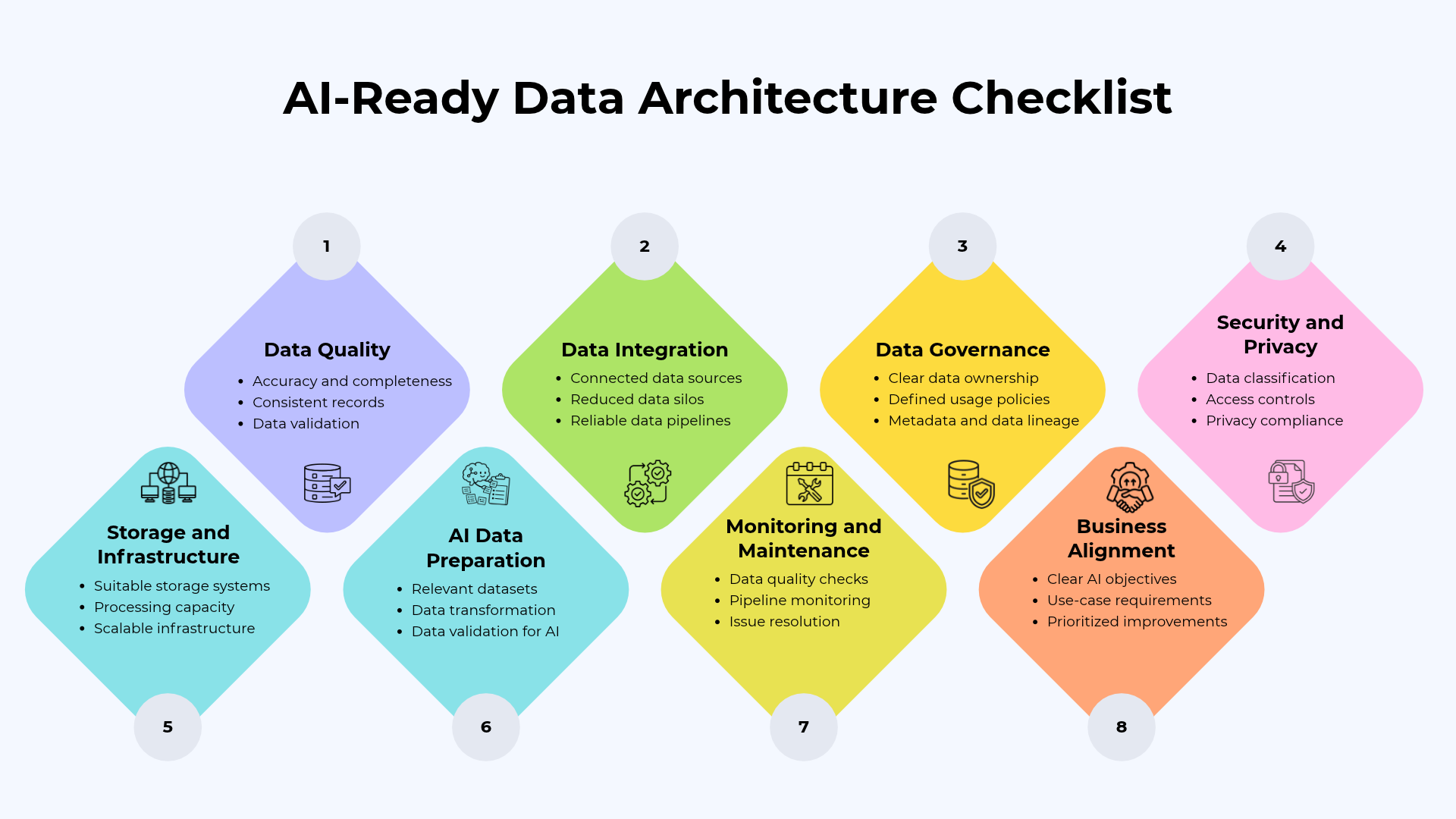
- Data Quality
- Verify data accuracy and completeness.
- Identify duplicate and inconsistent records.
- Establish data validation and cleansing processes.
- Data Integration
- Identify and connect relevant data sources.
- Address data silos across business systems.
- Evaluate data pipelines and integration methods.
- Data Governance
- Define data ownership and accountability.
- Establish data access and usage policies.
- Maintain metadata and data lineage.
- Data Security and Privacy
- Classify data based on sensitivity.
- Implement appropriate access controls and encryption.
- Review privacy obligations and compliance requirements.
- Storage and Infrastructure
- Evaluate existing databases and storage systems.
- Assess data processing capacity.
- Plan for scalability as data volumes and AI workloads grow.
- AI Data Preparation
- Identify datasets relevant to planned AI use cases.
- Define data transformation and preprocessing requirements.
- Validate data suitability before using it in AI applications.
- Monitoring and Maintenance
- Conduct regular data quality checks.
- Monitor data pipeline performance.
- Establish processes to detect and resolve data issues.
- Business Alignment
- Define clear objectives for AI initiatives.
- Map data requirements to specific business use cases.
- Prioritize readiness gaps and create an improvement roadmap.
Building an Enterprise Data Foundation for AI Success
A strong enterprise data foundation helps businesses prepare for AI adoption by establishing consistent ways to collect, organize, manage, and access information across the organization. While the checklist highlights key areas of readiness, businesses also need to connect these improvements through a clear plan that aligns data management practices with their AI objectives.
An effective AI data strategy helps define how data will support planned AI initiatives, which data sources are required, and what improvements are needed to make information reliable and accessible. It also helps organizations prioritize investments in data quality, integration, governance, and infrastructure based on their business requirements.
To build this foundation, businesses should focus on the following considerations:
- Align data initiatives with business goals: Identify the business problems AI is expected to address and determine the data required to support those objectives.
- Establish consistent data management practices: Define common standards for data quality, ownership, access, and maintenance across business functions.
- Address existing data gaps: Review disconnected systems, incomplete records, and limitations in data accessibility before introducing new AI workloads.
- Plan for responsible data use: Incorporate security, privacy, governance, and compliance requirements into data management processes.
- Review and improve continuously: Monitor data quality and infrastructure performance as business requirements and AI use cases evolve.
At T/DG, our data management services include capabilities such as data architecture analysis and design, data governance, data quality management, and master data management. These areas can help organizations evaluate their existing data environment and identify opportunities to strengthen how business information is managed.
By connecting data readiness assessments with a well-defined AI data strategy, businesses can establish an enterprise data foundation that supports their current information needs and prepares them for future AI initiatives.
Assessing Data Readiness and Infrastructure for AI
Evaluating data readiness for AI involves more than checking whether an organization has enough data available. Businesses must also determine whether their data is reliable, accessible, well-governed, and suitable for the intended AI use cases. This assessment helps identify technical and operational gaps that could affect implementation.
Alongside data quality and governance, organizations need to evaluate whether their AI data infrastructure can support the storage, processing, integration, and movement of information required by AI applications. The right infrastructure depends on factors such as data volume, processing requirements, existing systems, security needs, and the scale of planned AI workloads.
Key Factors to Evaluate
- Data availability and accessibility: Confirm that relevant datasets can be accessed by authorized teams and applications when needed.
- Infrastructure capacity: Assess whether existing storage, computing resources, and data processing systems can support anticipated workloads.
- Integration capabilities: Review whether data from different applications and platforms can be combined without introducing unnecessary complexity.
- Data protection: Ensure that infrastructure and data access processes support appropriate security, privacy, and compliance requirements.
- Scalability and performance: Determine whether the environment can accommodate increasing data volumes and changing processing demands.
- Operational monitoring: Establish processes to monitor data pipelines, identify failures, and resolve performance or quality issues.
At T/DG, our data management services include data architecture analysis and design, data warehousing, data governance, and data quality management. Evaluating these areas can help businesses understand their existing capabilities, identify gaps, and determine which improvements may be needed to support their AI objectives.
A clear assessment of data readiness for AI enables organizations to prioritize infrastructure improvements according to actual business and technical requirements rather than investing in unnecessary complexity.
Key Takeaways on AI-Ready Data Architecture
Preparing for AI adoption starts with understanding whether an organization's data environment can support its business objectives and technical requirements. From data quality and integration to governance, security, and infrastructure scalability, each area contributes to making information reliable and accessible for AI applications.
A well-planned enterprise data architecture helps businesses establish a consistent approach to managing information across systems while addressing data readiness, integration requirements, and future scalability. By identifying gaps early and aligning data management practices with a clear AI data strategy, organizations can prioritize improvements based on their needs.
At T/DG, our Data Management services cover areas such as data architecture, data governance, data quality management, and data warehousing. These capabilities can help organizations evaluate their existing data environment and plan for evolving business requirements.
Building an AI-ready data environment is an ongoing process that requires regular evaluation and improvement as business priorities and AI use cases evolve.
Need help assessing your organization's data management needs? Contact T/DG to discuss your business requirements and explore suitable data management solutions.
In our next blog, we'll compare data warehouses and lakehouses, explore their key differences in architecture, data storage, and processing capabilities, and understand how businesses can choose the right approach for their data requirements.
Your Questions About AI-Ready Data Architecture, Answered
What is an AI-ready data architecture? An AI-ready data architecture is a framework for collecting, storing, integrating, managing, and preparing data for AI applications. It helps ensure that information is accessible, reliable, secure, and suitable for the intended AI use cases.
Why is data architecture important for AI adoption? Yes, it plays a critical role. AI applications depend on reliable and accessible data to generate useful outputs. A well-planned data architecture helps businesses address data silos, inconsistent records, integration challenges, and governance gaps before implementing AI solutions.
What are the key components of an AI-ready data architecture? Key components include data quality management, data integration, data governance, security and privacy controls, scalable storage and processing infrastructure, data preparation, and continuous monitoring.
How can businesses assess data readiness for AI? Businesses can assess data readiness for AI by reviewing data quality, accessibility, integration capabilities, governance policies, security measures, and infrastructure capacity. Identifying gaps in these areas helps organizations prioritize improvements based on their AI objectives.
Does data quality affect AI performance? Yes, absolutely. Incomplete, inaccurate, or inconsistent data can affect the reliability of AI-generated outputs. Data validation, cleansing, and ongoing quality monitoring help organizations maintain data that is suitable for their intended AI applications.
What is the role of data governance in AI-ready architecture? Data governance establishes policies for data ownership, access, quality, security, and usage. It helps organizations manage information consistently and address privacy and compliance requirements when preparing data for AI.
What infrastructure is required for AI-ready data architecture? The required infrastructure depends on the organization's data volumes, AI use cases, processing requirements, and security needs. It may include databases, data warehouses, data lakes, integration pipelines, and scalable computing resources.
How does an AI data strategy support business goals? An AI data strategy connects data management priorities with business objectives. It helps organizations identify the data needed for planned AI initiatives, address existing gaps, and prioritize investments in data quality, governance, integration, and infrastructure.
How can T/DG help businesses prepare their data architecture for AI? T/DG offers Data Management services covering areas such as data architecture analysis and design, data governance, data quality management, master data management, and data warehousing. These services can help businesses evaluate their existing data environment and identify opportunities to improve data management in line with their requirements.
Write a comment

Subscribe To Our Newsletter
Join our mailing list to receive the latest blogs and updates.