Outsourced Product Engineering: A Decision Guide for Growing Teams
Outsourced Product Engineering: A Decision Guide for Growing Teams
You have a product idea, a launch date, and a team that is already stretched thin. Hiring more engineers could take months, and you do not have months. So you start wondering whether outsourced product engineering could get you moving sooner.
It can. But the result depends on the choices you make before anyone writes a line of code. A rushed decision leads to missed dates, messy handovers, and long email chains that nobody enjoys.
At T/DG, we wrote this guide to walk you through the decision one step at a time. It works whether you build tools for other businesses or apps for everyday customers, because the questions you need to ask are nearly the same.
What Outsourced Product Engineering Really Means
Product engineering is the full journey from idea to working software. It includes deciding what the product must do, planning how it will be built, writing the code, testing it, and looking after it once people start using it.
When you outsource it, an outside team takes on some or all of that work. You keep ownership of the product and the vision. The outside team brings engineers, testers, and designers who build alongside you.
This is different from plain outsourced software engineering, where a vendor writes code from a spec you hand over. With product engineering, the team also helps shape the requirements and plans the architecture. Architecture is just the blueprint that shows how the parts of your software fit together. A good team stays involved after launch, too.
When Outsourcing Makes Sense
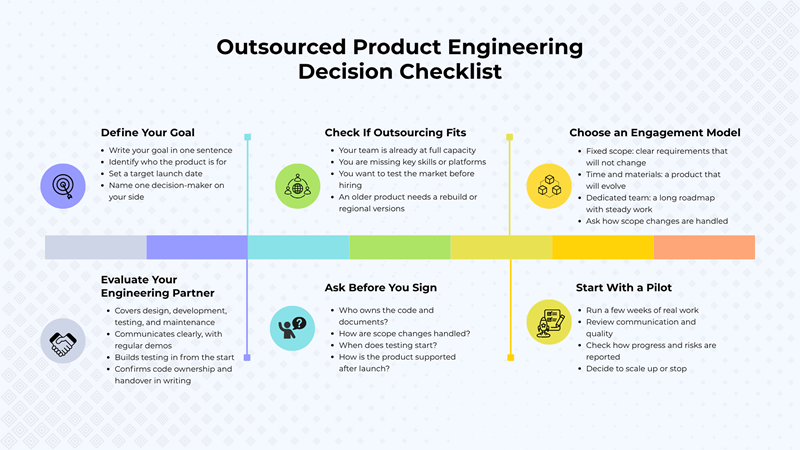
Look honestly at your own situation. Outsourcing tends to help in cases like these:
- Your team is full, and a new product keeps getting pushed back.
- You need a skill nobody on your team has, such as a tricky integration or a platform you have never used.
- You want to test a market before you commit to a permanent team.
- An older product needs rebuilding, but your engineers are busy keeping it alive.
- You need versions for different regions, with local languages or local rules.
Here is an imagined example, not a customer story. A small retail brand wants a loyalty app in four months. Its two developers already look after the website. Hiring and training new people would eat half the timeline. In a case like this, product development outsourcing fills the gap while the in-house pair keep the website running.
When It May Not Be the Right Move
Product engineering outsourcing is not a cure for every problem. Hold off if any of these sound like you:
- Nobody can explain who the product is for or what problem it solves. Sort that out first.
- The core technology is a trade secret that must stay inside your walls.
- No one on your side has time to answer questions and make decisions. Every outside team needs a quick-reply owner at your end.
An outside team can speed up a clear plan. It cannot rescue a product nobody has defined.
Pick the Right Engineering Engagement Model
An engineering engagement model is simply the way you and the outside team agree to work and to pay. It shapes your costs, your control over daily decisions, and how much stress you carry.
Most partners offer some mix of the three setups below. Ask each one which they support.
1. Fixed Scope- How it works: You agree on a set of features and a fixed price upfront.
- Works best when: Requirements are clear and unlikely to change.
- Watch out for: Any mid-project changes require a new agreement and may slow down progress.
- How it works: You pay for the work completed, usually by the hour or by sprint (a short work cycle).
- Works best when: The product may change as you learn from users.
- Watch out for: Costs can increase if they are not reviewed regularly.
- How it works: A dedicated group works exclusively on your product over an extended period.
- Works best when: You have a long-term roadmap and a steady flow of work.
- Watch out for: The team needs regular direction and feedback from you.
No model wins every time. A product with a firm scope may suit fixed pricing, while a product you will keep reshaping from customer feedback usually fits the other two better. Whichever you lean toward, ask how changes get handled once work has started. That answer tells you a lot.
How to Choose an Engineering Partner
Your engineering partner will sit inside your product for a long time. Treat the choice like hiring a senior colleague, not buying a printer.
Check the range of work
A partner that covers design, development, testing, and maintenance means fewer handoffs. Every handoff is a place where details get lost. Look for product engineering services that follow a product through its whole life, including reworking an older product when it needs it.
Look at how they communicate
Ask who you will speak with each week. Ask how often you will see working software, not just reports. Regular demos beat long status documents every time.
Ask how quality gets built in
Testing should begin early and run alongside development. If a partner talks about testing only as a final step, expect surprises close to launch.
Settle ownership and handover
Agree in writing that you own the code, the documents, and the access keys. Ask what a handover looks like if you ever move the work in-house or to another team.
Think about working hours
Overlap in working hours matters more than distance. A team with offices in several regions can often cover more of your day. T/DG, for example, has a presence in the USA, Canada, India, Fiji, and Vietnam.
How T/DG Approaches Product Engineering
T/DG offers product engineering services that follow a software product from its first sketch through its later years. In plain terms, the work covers:
- Writing down what the product must do and how well it must perform, so everyone shares the same picture.
- Planning the architecture and design and showing key parts of the product early.
- Building prototypes and testing them to spot likely failures before they reach customers.
- Reworking existing products and maintaining them across their lifecycle.
The goals T/DG sets for its clients include a shorter time to market, steady product quality, and software built around what customers need. You can read more on the T/DG product engineering page.
Questions to Ask Before You Sign
Take this list into every conversation with a possible partner.
- Who owns the code and the documents at the end?
- Who will I speak with every week?
- How do you handle a change in scope?
- When does testing start, and who does it?
- What happens if a key engineer leaves the team?
- How will you report progress and risks?
- What do you need from us to move quickly?
- How do you support the product after launch?
If a partner dodges two or three of these, treat that as your answer.
A Simple Way to Decide
If you like a plain sequence, use this one.
- Write down your goal in one sentence. If you cannot, the project is not ready yet.
- List the skills and hours you are missing. Be specific, such as two mobile developers and one tester.
- Decide how much day-to-day control you want. Some teams want daily say. Others only want a weekly check-in.
- Choose the engagement model that matches. Use the table above as your starting point.
- Shortlist two or three partners. Put the questions from the list to each of them.
- Start with a small pilot. A few weeks of real work shows you more than any sales call.
Common Mistakes to Avoid
- Picking only the lowest quote. A cheap start can turn costly when work has to be redone.
- Leaving requirements vague and hoping the partner fills the gaps.
- Having no decision-maker on your side.
- Treating the outside team like strangers. Share the reasons behind the product, not only the task list.
Key Takeaways
- Outsourced product engineering works best when your goal is clear and someone on your side owns decisions.
- It goes beyond writing code. A good partner helps with planning, testing, and upkeep.
- Pick the engagement model based on how much your scope is likely to change.
- Judge an engineering partner on communication, quality checks, and ownership terms, not on price alone.
- A small pilot lowers your risk before the full build.
Final Thoughts on Outsourced Product Engineering
Choosing outsourced product engineering is not about handing off your problems. It is about adding the right people at the right time, with clear rules for how you will work together.
Start with your goal, be honest about your gaps, and test the partnership with a small first step. If you want to talk it through, contact our team at T/DG.
Write a comment

Subscribe To Our Newsletter
Join our mailing list to receive the latest blogs and updates.