Best Practices for Developing an Effective Master Data Management Strategy
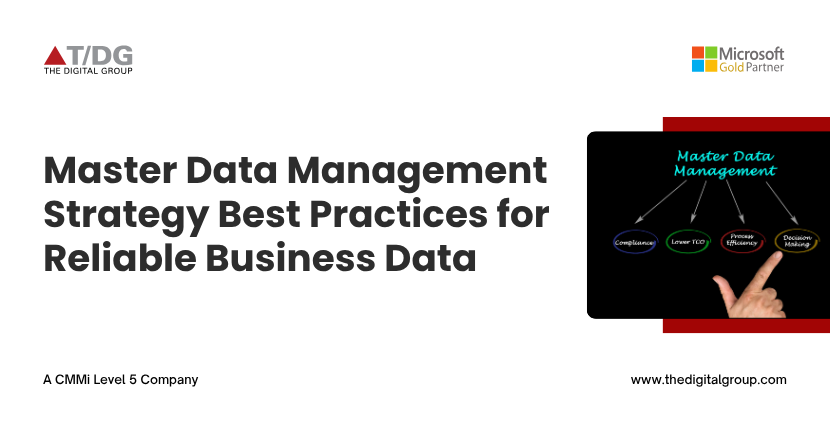
Why Your Business Needs a Master Data Management Strategy
Ask three departments for the same customer’s address and you may get three different answers. Sales has one in the CRM, finance has another on the invoice, and support is working from a spreadsheet someone exported last spring. Nobody did anything wrong. The data just lives in too many places.
Master data management (MDM) exists to fix that. A master data management strategy decides which version of your core records (customers, products, suppliers) counts as the right one, and how every other system stays in line with it. Without that decision, people end up second-guessing the numbers in front of them.
This is the kind of problem T/DG’s data management team is set up to handle: data that isn’t integrated, copies that disagree, information nobody can find when it’s needed. Below are the practices we’d start with.
Start with an MDM Operating Model
Before you buy anything or move any data, work out how your organization will run MDM day to day. Who decides what a correct record looks like? Which teams are involved? What happens when two systems disagree?
Try it on one scenario. A customer moves and updates their billing address. Does that change reach the other systems automatically, or does someone have to remember to do it? If nobody can answer, you don’t have an MDM operating model yet.
T/DG can step in at whatever stage you’re at, whether that means reviewing how data is handled today or shaping the model around the teams and systems you already have.
Put Data Stewardship and Master Data Governance in Place
Data stewards are the people who keep an eye on a particular kind of data. They check it, fix it, and chase down the cause when something looks wrong. Give your customer records a steward, for example, and duplicates get caught early instead of turning up two years later during a migration.
Master data governance sits behind that work. It’s the set of rules covering who can view or change a record, how quality gets checked, and what happens when two records conflict. Skip it and each team invents its own habits, which is how records drift apart.
Governance, data quality management and data security are all core to T/DG’s data management work. We help teams agree on the rules and responsibilities up front, so quality checks become part of the routine.
Give Every Key Data Set an Owner
Stewards do the daily upkeep. Owners make the final call. Every major data set needs one person or team who approves changes and settles disputes.
Usually, the owner is whoever knows the data best. Finance might own supplier records, sales might own customers. Write it down. Then when a record is wrong, people know who to ask, and shared data stops being everybody’s problem and nobody’s job.
T/DG can help you map which team owns which data and agree how changes get approved, so ownership is documented rather than assumed.
Choose a Master Data Architecture That Fits What You Already Have
Your master data architecture decides how data is collected, stored, shared and updated. Before picking one, take stock. Which systems hold the important records? Where are the duplicates? How does information move between applications today?
Get those answers first and you can design around your real processes instead of fighting them.
Building master data architecture is one of T/DG’s areas of technical expertise. It sits alongside our data architecture analysis and design, reference and master data management, and data warehousing and business intelligence services. We also have experience with many popular open source databases and advanced data platforms, so we can work with the technology you already use.
How T/DG Approaches Master Data Management Projects
We prototype early. Before a data model goes anywhere near production, we test whether it actually works for the business, and we stay on the project until the improvement is built and tested.
With a close working relationship between your team and ours, a working system can be in place within the first 10 weeks. Roughly: three weeks on requirements and architectural analysis, three on analysis and design aimed at reusable assets, and four weeks of iterative sprints that deliver in increments. ETL best practices, code reviews, and unit and integration testing run through all of it.
Putting It Together
To recap, an effective MDM strategy needs an operating model, stewardship and governance, clear ownership, and an architecture that suits your setup. Get those right and duplicate and outdated records drop, and it’s obvious who’s responsible for what.
Where you start depends on where you are now. Look at your current systems, your known data quality problems, your integration needs, and where you want to be in a few years. T/DG offers market-ready solutions on leading data platforms, with a focus on lower total cost of ownership and more transparent information for decision-making. If you want to talk it through, contact T/DG and we’ll help you work out a sensible approach.
Coming up next: a product development checklist covering planning, development, testing, and delivery, plus ways to spot gaps in your engineering process and keep product work aligned with business and user needs.
Your Questions About Master Data Management Strategy, Answered
What is a master data management strategy? A master data management strategy defines how an organization manages important business information, such as customer, product, and supplier data. It establishes clear responsibilities, processes, and rules to help maintain accurate and consistent records across different systems.
Why is a master data management strategy important for businesses? A master data management strategy helps businesses reduce duplicate records, address inconsistent information, and improve the reliability of data used across departments. It also helps teams follow common practices when creating, updating, and managing business information.
What are the key components of a master data management strategy? The key components include an MDM operating model, data stewardship, master data governance, clear data ownership, data quality practices, and a suitable master data architecture. Together, these elements help businesses define how information is managed and maintained across systems.
What is an MDM operating model? An MDM operating model defines how master data management works within an organization. It outlines responsibilities, decision-making processes, and collaboration between teams to ensure business information is managed consistently.
How does data stewardship support master data management? Data stewardship assigns responsibility for maintaining specific types of data, checking its accuracy, and resolving data quality issues. It helps ensure that teams follow agreed practices and keep important business records up to date.
What is the role of master data governance? Master data governance establishes rules and policies for managing business information. It helps define who can access or update data, how data quality is monitored, and how inconsistencies are identified and addressed.
Why is data ownership important in an MDM strategy? Data ownership establishes accountability for specific types of information. When data owners and their responsibilities are clearly defined, teams know who should approve changes, correct errors, and maintain the accuracy of records.
What should businesses consider when building a master data architecture? Businesses should assess their existing systems, data sources, integration requirements, duplicate records, and information-sharing processes. These considerations help them plan an architecture that supports consistent data management across applications.
How can businesses improve data quality as part of their MDM strategy? Businesses can establish data quality rules, assign responsibility for maintaining records, identify and resolve duplicate entries, and regularly review information for errors or outdated details. Consistent processes help maintain reliable data over time.
How can T/DG help businesses develop a master data management strategy? T/DG helps businesses assess their existing data environments and plan data management approaches aligned with their requirements. Its data architecture services include evaluating architecture components, understanding data patterns, and planning data integration, warehousing, and reporting strategies.
Write a comment

Subscribe To Our Newsletter
Join our mailing list to receive the latest blogs and updates.