HRMS vs ERP vs HCM: Which Solution Is Right for Your Business?
HRMS vs ERP vs HCM: Understanding the Differences
As organizations continue to modernize their operations, selecting the right business management solution has become increasingly important. While HRMS, ERP, and HCM are often used interchangeably, each serves a distinct purpose and addresses different organizational needs. Understanding these differences is essential for businesses looking to improve workforce management, streamline operations, and support long-term growth.
Digital HRMS helps organizations simplify and automate core HR functions through a centralized platform designed for modern workforce management. Whether you're evaluating an HR solution for the first time or planning to upgrade your existing system, understanding HRMS vs ERP vs HCM will help you choose a solution that aligns with your business objectives, operational requirements, and future growth plans. This HR software guide explains the purpose, features, and key differences between these systems to help you make an informed decision.
What Is an HRMS?
A Human Resource Management System (HRMS) is a comprehensive software solution designed to manage and automate an organization's core HR functions. It centralizes employee information and simplifies everyday HR activities such as attendance tracking, leave management, payroll processing, performance management, recruitment, onboarding, and statutory compliance. By replacing manual processes with digital workflows, HRMS helps organizations improve operational efficiency, reduce administrative effort, and maintain accurate employee records.
Digital HRMS enables organizations to manage the complete employee lifecycle through a single, integrated platform. With real-time workforce visibility, automated HR processes, and centralized data management, businesses can improve decision-making, strengthen compliance, and create a seamless employee experience. For organizations focused on optimizing HR operations, an HRMS serves as the foundation for efficient workforce management and long-term organizational growth.
Why Do Businesses Often Confuse HRMS, ERP, and HCM?
Although HRMS, ERP, and HCM are designed to support business operations, they serve different purposes and address different organizational requirements. The confusion often arises because these systems share certain HR-related functionalities, such as employee data management, payroll, and reporting. However, their scope, capabilities, and primary objectives vary significantly.
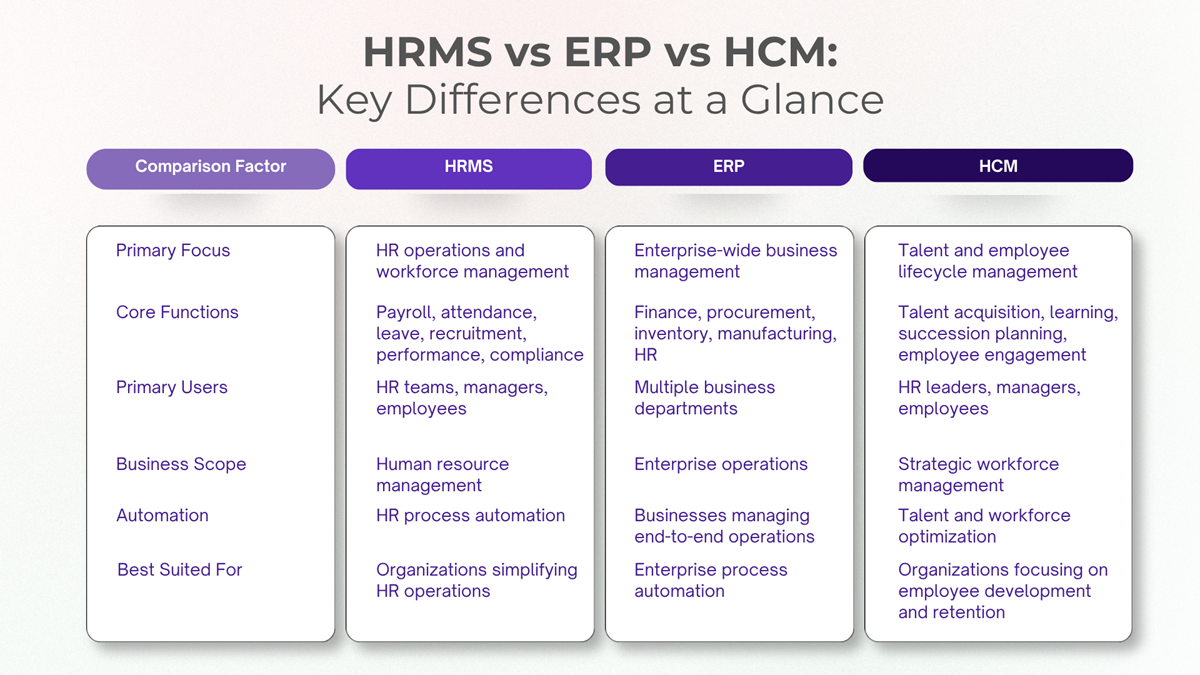
An HRMS focuses on streamlining and automating day-to-day human resource operations. An ERP manages broader business functions, including finance, procurement, inventory, manufacturing, and HR, through a unified enterprise platform. An HCM extends beyond traditional HR management by emphasizing talent acquisition, employee development, succession planning, and workforce engagement throughout the employee lifecycle.
HRMS vs ERP vs HCM: Which Solution Does Your Business Really Need?
Many organizations assume that HRMS, ERP, and HCM offer the same capabilities because they all include some level of employee data management. However, each solution is designed for a different business objective. Understanding these differences helps businesses invest in the right technology instead of paying for features they may never use.
HRMS – Built Specifically for HR Operations
An HRMS is designed to simplify and automate everyday HR activities such as employee records, attendance, leave, payroll, recruitment, performance management, and compliance. Digital HRMS provides organizations with a centralized platform that improves HR efficiency, enhances employee experiences, and supports better workforce management.
Ideal for organizations that want to:
- Automate HR operations
- Improve payroll accuracy
- Manage employee attendance and leave
- Ensure statutory compliance
- Enhance employee self-service
ERP – Designed for Enterprise Operations
An ERP system manages multiple business functions such as finance, procurement, inventory, manufacturing, and customer relationship management. While many ERP solutions include an HR module, HR is only one component of a much larger enterprise system.
Organizations looking primarily to modernize their HR operations may find ERP platforms more complex and resource-intensive than necessary.
HCM – Focused on Talent Development
HCM extends beyond traditional HR administration by concentrating on talent acquisition, learning, succession planning, employee engagement, and long-term workforce development. It is generally suited for enterprises with mature talent management strategies rather than organizations seeking to automate day-to-day HR operations.
Why HRMS Is the Right Choice for Most Organizations
For businesses looking to improve HR efficiency without investing in a large enterprise platform, HRMS software offers the right balance of functionality, flexibility, and scalability. Unlike ERP systems that manage multiple business departments or HCM platforms that focus primarily on talent strategy, Digital HRMS is purpose-built to simplify HR operations while supporting compliance, payroll, attendance, performance management, and employee engagement through a single integrated solution.
Organizations choosing Digital HRMS benefit from:
- Centralized employee management
- Automated payroll and attendance
- Simplified statutory compliance
- Improved employee self-service
- Faster HR decision-making
- Scalable HR processes for growing businesses
Key Takeaways: Choosing the Right HR Solution for Your Business
Choosing between HRMS, ERP, and HCM ultimately depends on your organization's priorities and long-term business goals. While ERP supports enterprise-wide operations and HCM focuses on strategic talent management, an HRMS is purpose-built to simplify and automate everyday HR processes. For organizations seeking to improve workforce management, enhance employee experiences, and maintain compliance without unnecessary complexity, an HRMS offers the most practical and efficient solution.
Digital HRMS empowers businesses with an integrated platform that streamlines payroll, attendance, leave management, recruitment, performance management, and compliance through intelligent automation. By centralizing HR operations and providing real-time workforce insights, Digital HRMS enables organizations to build a more productive, compliant, and future-ready workplace.
Ready to simplify your HR operations? Contact the Digital HRMS team today to discover how an intelligent HRMS solution can help your organization improve efficiency, strengthen workforce management, and support long-term business growth.
In our next blog, we'll explore how AI is transforming HRMS by enabling smarter automation, predictive workforce insights, and more efficient HR decision-making.
Quick Answers to Common HRMS, ERP, and HCM Questions
What Is the Difference Between HRMS, ERP, and HCM?
HRMS focuses on managing and automating core HR functions such as payroll, attendance, leave, recruitment, and compliance. ERP manages multiple business operations, including finance, procurement, inventory, and HR, through a unified platform. HCM extends beyond HR administration by emphasizing talent acquisition, employee development, succession planning, and workforce engagement.
Which Solution Is Best for Managing HR Operations? Absolutely. If your primary objective is to simplify HR processes, improve workforce management, and automate routine HR tasks, an HRMS is the most suitable solution. It is specifically designed to meet the day-to-day needs of HR teams while enhancing operational efficiency.
Should Growing Businesses Invest in ERP or HRMS? Certainly. The right choice depends on your business requirements. Organizations seeking enterprise-wide process management may benefit from an ERP system, while businesses focused on improving HR operations, payroll, attendance, and employee management will find an HRMS to be a more practical and cost-effective solution.
How Does Digital HRMS Help Organizations Improve Workforce Management? Yes.
Digital HRMS centralizes employee information, automates enterprise HR solutions, streamlines payroll and attendance management, strengthens statutory compliance, and provides real-time workforce insights. This enables organizations to improve efficiency while delivering a better employee experience.
Can HRMS Support Future Business Growth? Definitely. A modern HRMS is designed to scale with your organization by automating HR operations, improving workforce visibility, and adapting to changing business requirements. As organizations grow, an HRMS provides the flexibility needed to manage an expanding workforce efficiently while supporting long-term business success.
Write a comment

Subscribe To Our Newsletter
Join our mailing list to receive the latest blogs and updates.